

Introduction
The headline numbers have circulated widely: rates in the hundreds of percent, suppliers priced out of the U.S. market, and a good deal of commentary on what it all means. Harder to find is a direct answer to the question that matters most at a purchasing desk – what these duties do to the cost of a single drum.
This post addresses that directly. It covers what Commerce finalized, then works through the arithmetic on a single container so you can apply the same method to your own pricing.
What Commerce Finalized
On June 16, 2025, the U.S. Department of Commerce announced its final affirmative determinations in the antidumping and countervailing duty investigations of certain brake drums from China and Türkiye. The case originated with a petition filed by Webb Wheel Products in June 2024.
Two distinct duties resulted from the case, and the distinction matters for the calculation.
- Antidumping duties address merchandise sold into the U.S. below fair value.
- Countervailing duties offset government subsidies in the exporting country.
The two are calculated separately and apply together, so an importer of subject goods pays both.
>>> Read more: U.S. Finalizes CVD Orders on Brake Drums from China and Turkey
The Final Rates
The principal distinction in the results is between exporters that cooperated with the investigation and those that did not.
Suppliers that participated fully received comparatively modest rates. Those that did not were assigned rates based on adverse facts available, at the upper end of the scale.
The two AD columns are not a discrepancy:
- The dumping margin is the rate Commerce calculates as the result of the investigation.
- The cash deposit rate is what an importer actually posts at the border.
When a product faces both an AD and a CVD order, certain export subsidies can be counted twice – once in the CVD rate, and again inside the dumping margin – so Commerce reduces the AD cash deposit by that amount to avoid double-charging.
That is why the China-wide deposit (150.25%) sits below its margin (160.79%), while the cooperative rate, with no such overlap, is identical in both columns.
Türkiye follows the same pattern. EKU Fren and the all-others group post 12.86% AD and 2.80% CVD at entry. Suppliers with incomplete submissions post 146.93% and 131.60% – a difference large enough to affect a supplier’s viability in the U.S. market.
Tariff Calculation Step by Step
One detail is frequently omitted from coverage: both duties are assessed on the customs value of the goods, not the retail price and not the price after freight. An error at this point carries through every figure that follows. The base formula is straightforward:
Landed cost adds that duty to the other costs of bringing the drums to your dock:
The following example applies the formula. A distributor imports one container of 400 brake drums from a non-cooperative Chinese exporter, at a customs value of $40 per drum.
The example uses the cash deposit rate rather than the dumping margin, because the cash deposit is the figure actually posted at the border – the amount that determines what the importer pays.
On this basis, $16,000 of brake drums carries approximately $95,500 in duty. The value at the point of customs clearance rises to roughly seven times the invoice amount – and that is with only AD and CVD applied.
The same container sourced from a non-cooperative Turkish supplier, at 146.93% AD and 131.60% CVD, carries approximately $44,565 in duty on the identical $16,000 of goods.
Where Vietnam Fits In
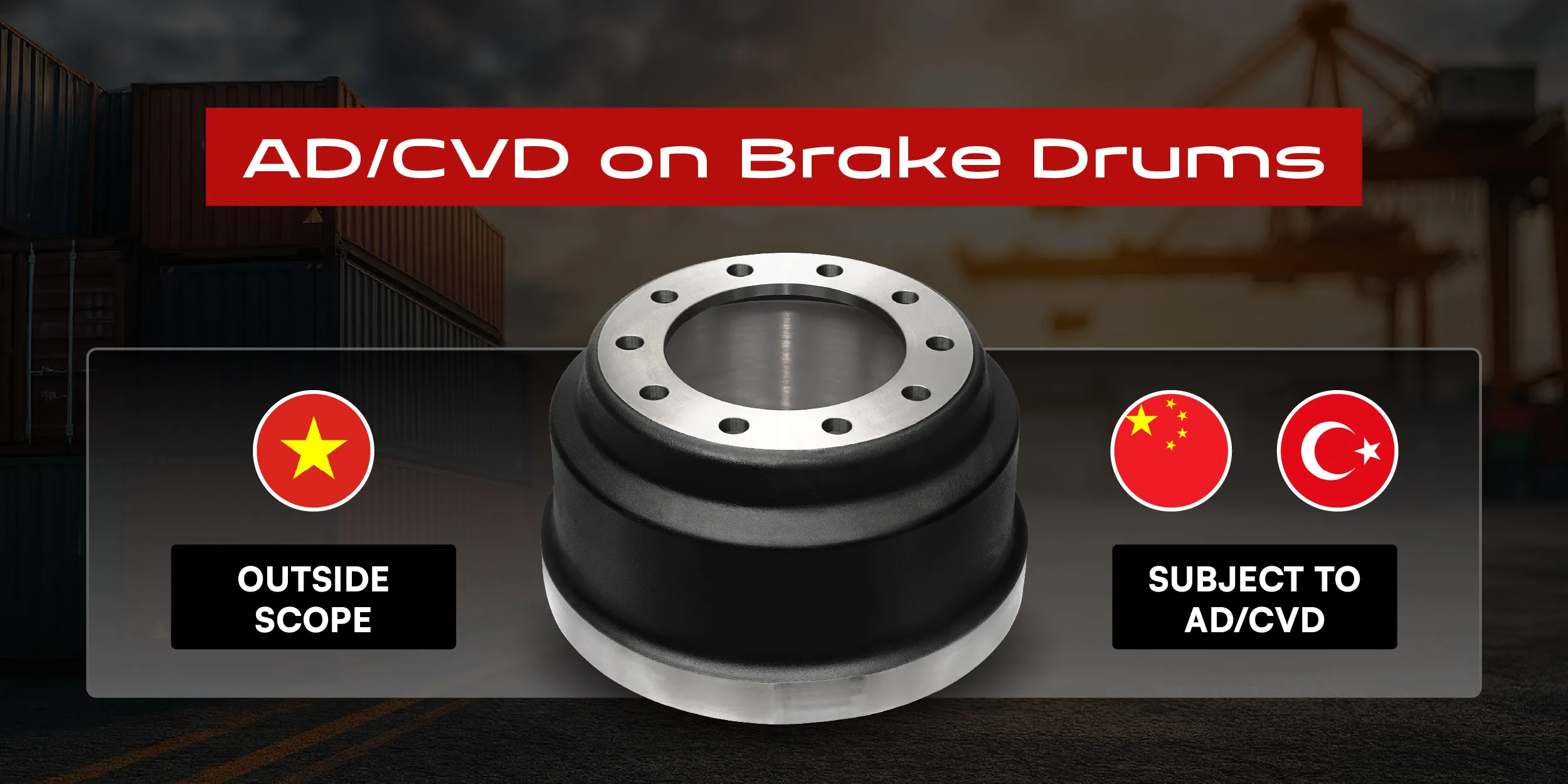
The AD and CVD orders are defined by origin – they apply to only brake drums manufactured in and exported from China and Türkiye.
Brake drums produced in Vietnam fall outside the scope of the case, so they are not subject to AD and CVD.
This is the reason supplier country has become a more prominent sourcing variable, alongside unit price and lead time. A drum that appears inexpensive on the invoice can carry a higher landed cost than one priced higher up front, and the way to know is to run the numbers before committing.
TBP Auto's brake drums are manufactured in Vietnam, outside the scope of these orders. For buyers working through the calculation, we can provide both the customs-value basis and the origin documentation, so the full landed cost is transparent before any purchase is made.
Contact us today and build your brake drum plan for the long-term.
